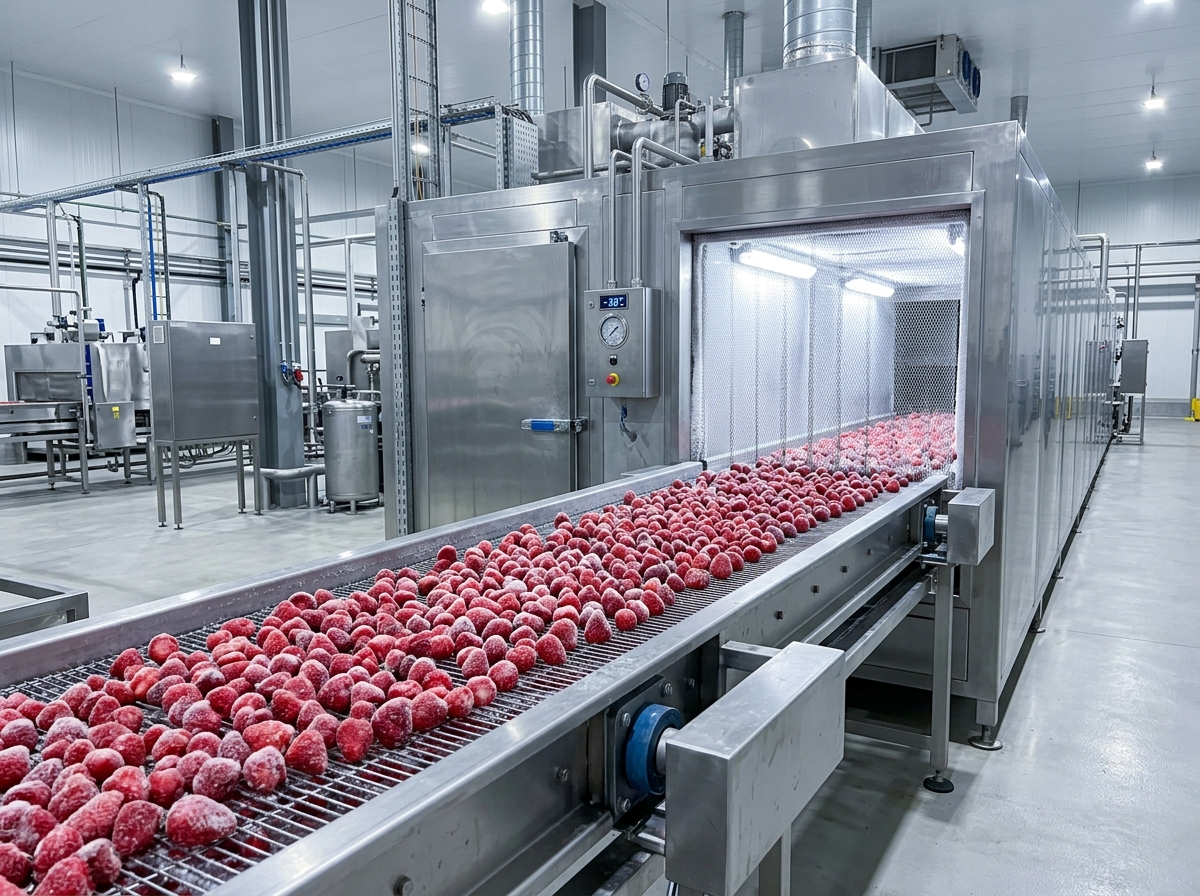
Most explanations of IQF stop at the acronym. Individual quick freezing is worth understanding properly, because everything a buyer notices when the carton is opened — whether the pieces pour, whether they bleed on the bench, whether the texture survives into a finished product — traces back to a single physical event that lasts a few minutes.
Ice crystals are the whole argument
Fruit is mostly water held inside cells. When it freezes slowly, water migrates out of the cells before it solidifies and forms large crystals in the spaces between them. Those crystals grow, press against and puncture cell walls. The damage is invisible while the product is frozen and obvious the moment it thaws: the structure has nowhere to hold its juice, so the juice leaves. That is drip loss, and it is a texture problem before it is a weight problem.
Freeze the same fruit fast and the water has no time to migrate. Crystals form small, in place, and largely inside the cells that already contained the water. Cell walls stay intact, and on thawing the fruit behaves much more like fruit.
IQF is a preservation process, not an improvement process. The fruit leaves the tunnel at the quality it entered with — the tunnel only decides how much of that quality survives to the buyer.
Why individual matters commercially
The second half of the acronym is a commercial property rather than a food-science one. Pieces frozen separately stay free-flowing, which means:
- A processor can weigh out exactly the quantity a batch needs and return the rest to the freezer, without thawing and refreezing a solid block.
- Mixing ratios in a blend stay accurate, because the pieces are individually dosed rather than broken off a mass.
- Handling losses drop, because nothing has to be cut, chipped or dropped to be separated.
A block-frozen equivalent may be cheaper per kilogram and considerably more expensive per usable kilogram.
What the fluidised bed is doing
In a fluidised-bed tunnel, cold air is driven upwards through a perforated belt with enough velocity to lift and agitate the pieces as they travel. Two things happen at once. The agitation keeps pieces from touching long enough to weld together, and the airflow around every surface takes heat out far faster than static air ever could — the surface crusts first, which is what stops pieces from bonding, and the core follows.
Once frozen, product is packed and held at −18°C. Everything after the tunnel is maintenance: the cold store, the reefer set point and the delivery are all simply protecting a structure that was decided in those few minutes.
Formats and what they are for
- Whole — visual presence in a finished product; dessert toppings, premium retail bags
- Halves — a compromise between appearance and even dosing on a line
- Diced — bakery inclusions and preparations where distribution matters more than silhouette
- Crumble / pieces — juicing, purée bases, flavour systems where structure is not the point
What IQF cannot fix
It cannot add flavour that the field did not produce, and it cannot repair fruit that was already soft when it reached the line. A tunnel operating perfectly on marginal fruit produces well-preserved marginal fruit. This is why the frozen specification has to be decided before the harvest, not after it — a point made at more length in Beheira field notes.